


























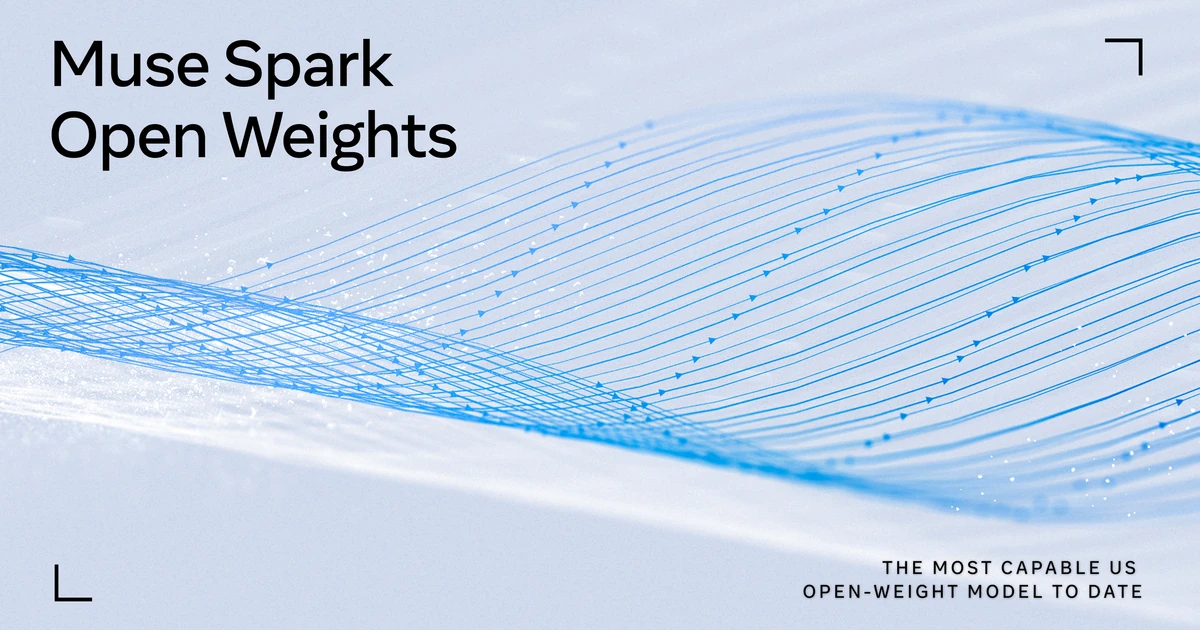
Meta released Muse Spark Open on October 15, 2026, with downloadable weights and optimizations for Apple’s M5 Ultra Mac Studio. In its announcement, Meta describes a desktop setup that pairs two machines with up to 512 GB of unified memory each. Together, they provide a terabyte of unified memory.
The model has 816 billion total parameters, with 42 billion active, and a one-million-token context window. Meta built it for coding, AI agents and multi-step reasoning. However, its Mac demonstration depends on a pair of high-memory desktops; the announcement does not describe running that setup on a single MacBook.

Why Meta pairs two Mac Studios
Apple’s unified memory architecture lets the M5 Ultra’s integrated GPU use up to 512 GB per Mac Studio, Meta says. As a result, two machines can hold the entire model. Meta also cites the chip’s 1.2 TB/s memory bandwidth, which it says can read the portion of the model each token needs.
The company optimized Muse Spark Open for Apple silicon using the latest MLX framework. Specifically, its description of the desktop configuration names two M5 Ultra Mac Studios. The announcement does not specify the purchase price or shipping date for those computers, so it does not establish what that local setup costs or when a buyer can assemble it.
Meanwhile, Meta says it tested agent workflows running entirely on-device through Muse Code powered by the model. One involved changes to Ice Cubes, an open-source Mastodon client. The work included bug fixes, new features and a full build.
Another demonstration used DaVinci Resolve. Meta says the model reviewed footage frame by frame, selected strong moments and cropped them vertically. These are Meta’s reported tests; the release does not establish how the model will perform on a reader’s own projects.
Muse Spark Open also runs beyond Macs
The Apple configuration is one route to the model. Meta also lists support through SGLang, vLLM, TensorRT-LLM, Hugging Face Transformers, llama.cpp and Unsloth. Additionally, it describes optimizations for AMD, Apple, Intel and NVIDIA silicon.
For developers who want to customize the model, Meta points to PyTorch and TorchTitan for further tuning. To run it on Apple silicon, the company directs developers to MLX, which pulls the weights from Hugging Face.
Alternatively, users can access the model through hosted API platforms. Meta names Baseten, Fireworks AI, Groq, Modal, Nebius, OpenRouter and Together AI as available on launch day. The announcement does not specify their pricing, geographic availability or account eligibility rules.
Download channels also include Amazon SageMaker AI, Google Cloud Model Garden, Hugging Face and Microsoft Foundry Models. In addition to the desktop configuration, Meta’s release lists hosted access and downloadable weights as options.
Open weights come with license conditions
Meta is releasing the weights under the Muse Model License with limited commercial terms. It says those terms allow many developers to use the model for free. However, that wording does not promise unrestricted free commercial use for everyone; developers need to check the license for their intended use.
Finally, Meta says the open-weight model received additional safety post-training and met its framework’s release thresholds. Detailed results appear in the model card, according to the company, while a full evaluation report is coming soon. That distinction matters: the announcement describes the report as forthcoming, rather than already available.